

Almedreha.. Rituals of Farewell and Reception of Pilgrims in Old Sana’a for Centurie
Yemenat
Mohammed Al-Mekhlafi
O wooden swing, O crafted frame,
Who set your timbers in evening’s hush?
Who fixed your pillars under the moon,
And lit the candle’s gentle blush?
This is how the people of Old Sana’a used to bid farewell to pilgrims before their journey to Makkah, through these traditional chants.
With the approach of the Hajj season, the old neighborhoods would begin preparing for this occasion, as relatives and neighbors gathered around the pilgrim before his departure.
The pilgrim would visit the homes of his relatives and neighbors to say goodbye, and then proceed to the neighborhood mosque to request prayers.
There, people would gather around him, shake his hand, and pray for his safe journey and accepted pilgrimage.
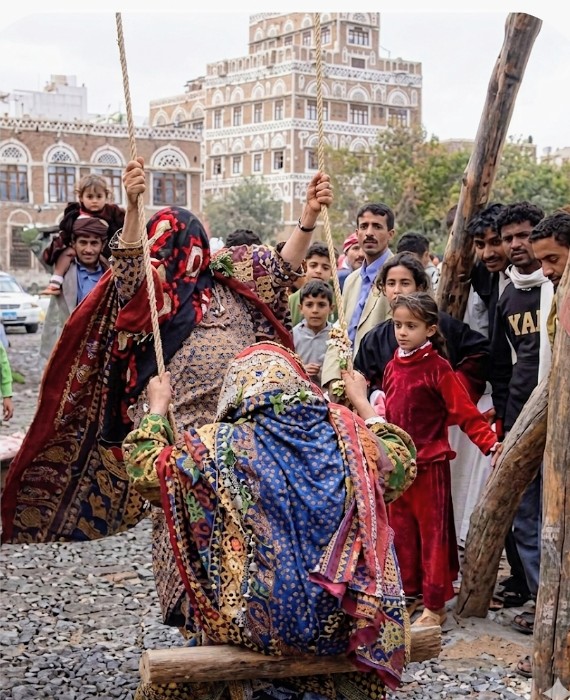
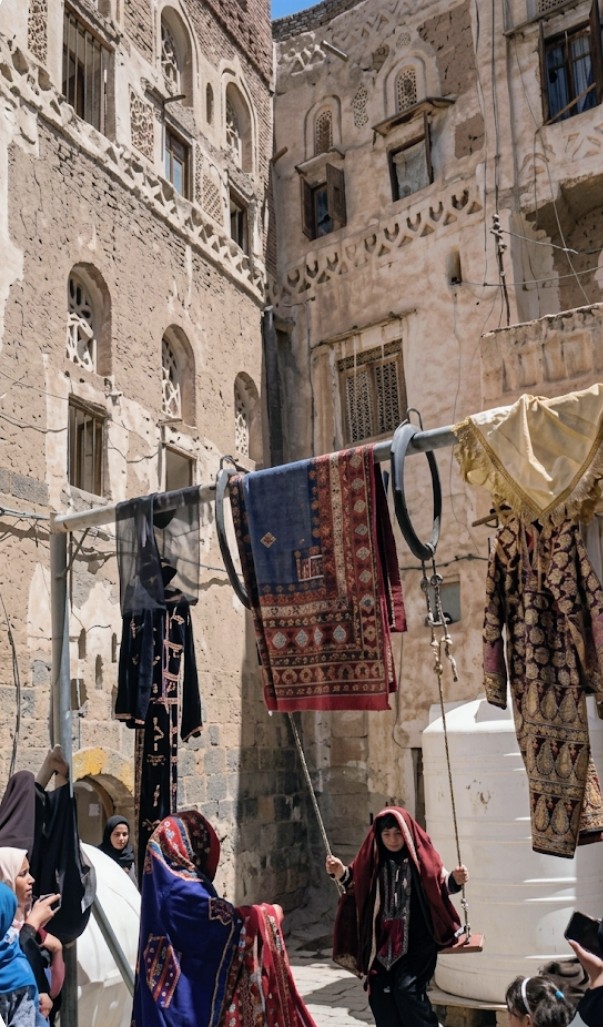
One resident of Old Sana’a, Abdullah Al-Qadhi, says that one of the most prominent customs associated with Hajj in Sana’a is Al Medreha (the swing), a wooden swing erected in the courtyard of the main house or in the neighborhood square.
Al Medreha was adorned with the pilgrim’s own clothing; if the pilgrim was a man, his traditional garments would be hung on it, such as the thobe, “somata,” (a traditional shawl-like garment worn over the neck and shoulders), the jambiya, (A traditional Yemeni curved dagger worn at the waist) and the vest of al-za‘al. If the pilgrim was a woman, her appropriate garments would be hung instead, and Al Medreha would be decorated with small iron bells that produce light sounds as it moves.
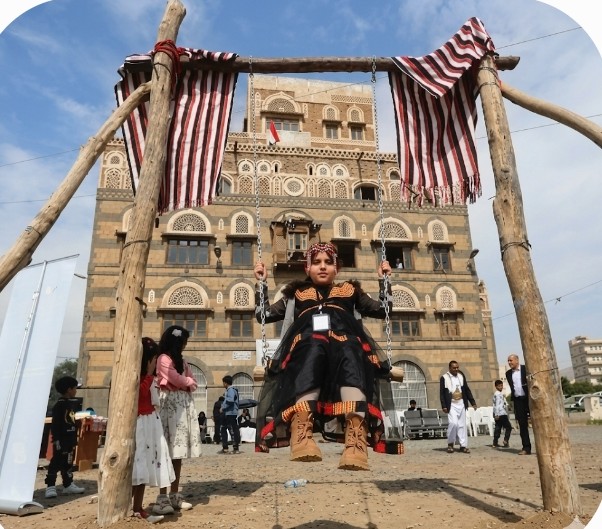
The women would also decorate the ropes of the Medreha with (al-mashaqir), such as shadhab and basil, local plants whose fragrant scent fills the alleys of the neighborhoods.
Historical sources indicate that the tradition of the Medreha has been present in Yemen for more than 1,200 years, and over time it has become part of the popular heritage associated with Hajj.
When Al Medreha was installed, women and children would chant:
O wooden swing, O wooden swing,
Why does your voice so faintly ring?
She said: I am weak, none clothed me here,
My robe is iron, two pounds I wear,
And Roman wood.
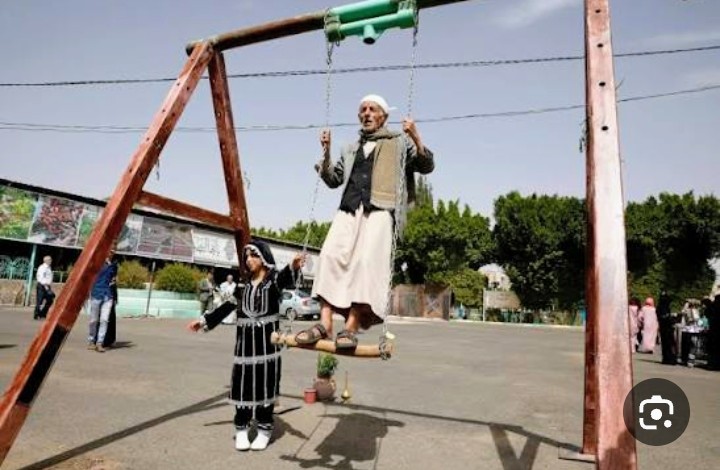
People were keen to secure Al Medreha firmly in place, because its collapse or imbalance was considered an unfavorable sign, and some would interpret it as an omen of misfortune for the pilgrim or his journey.
With the passage of time and the transformation of life in the old cities, the presence of the Medreha gradually diminished due to the narrowing of spaces and the disappearance of many large courtyards. However, the custom of bidding farewell to pilgrims still exists in Sana’a and in some Yemeni regions to this day.
Al Medreha is linked to an old era when the Hajj journey was long and exhausting, as pilgrims used to travel on camels and mules, and the journey sometimes took three or four months.
At that time, there were no means of communication between the pilgrim and his family, so people lived through a long period of anxiety and waiting until the pilgrim returned safely; thus, Al Medreha became a means through which people expressed their longing and prayers for the pilgrim during his absence.
Among the chants that describe the moment of farewell:
If you could see, O gathered ones,
when he said: “Peace be upon you,” and departed…
No… the one in praise of God rose up and cried,
calling the Name of God aloud in sorrow…
The place itself cried from its loneliness,
and the children wept with longing hearts…
These words describe the state of sorrow experienced by the pilgrim’s family after his departure, especially the children and members of the household.
During the period of the pilgrims’ absence, men, women, and children would gather around the Medreha and recite traditional folk chants, among the most well-known of which are:
O dove of Arafat, O dove of Arafat,
circle and circle, keep circling high…
do not fall asleep, do not drift to sleep,
and know where our pilgrim is tonight…
In this chant, the people symbolically ask the dove to watch over the pilgrim and protect him. They would also recite:
O our pilgrim, rise and bind your saddle tight,
and say to Makkah: my heart says farewell…
I am returning now to my homeland.
Upon the return of pilgrims to Old Sana’a, the neighborhoods would be filled with people welcoming them back. Men and children would go out to celebrate their arrival at Bab Al-Yemen, at the entrances of the city, and throughout the neighborhoods. Expressions of congratulations would echo everywhere, such as: “May your Hajj be accepted, your effort rewarded, your sins forgiven, and your trade never perish,” and “May God accept your acts of worship,” and “Praise be to God for your safe return,” and “You have illuminated Sana’a.”
O bearer of glad news, your news is joy,
your tidings are joy upon joy…
we rejoice for you, O our pilgrim,
you have won forgiveness and divine grace…
you have visited the Prophet’s resting place,
and touched the sacred corners of the House.
The celebrations would continue for several days, during which feasts known as (Al-Naqi‘ah) would be held, and relatives and neighbors would gather to greet the pilgrim and listen to stories of the journey. Among the old customs as well was that people would paint the facades of pilgrims’ houses with white “nura” as an expression of joy upon their return.
Although many of these customs have begun to fade over time, Al Medreha remains alive in the memory and hearts of the people, as one of the most beautiful traditional practices associated with Hajj in Sana’a.